 Call Us — +1 (929) 201-3767
 info@childrenpublishers.com

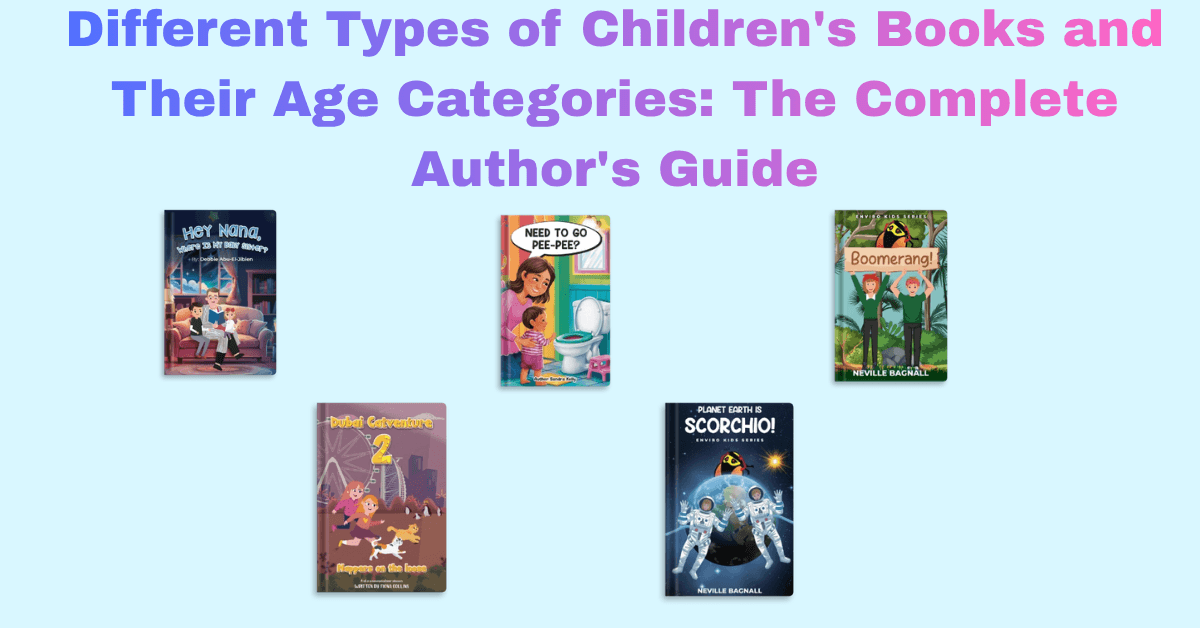
Different Types of Children’s Books and Their Age Categories: The Complete Author’s Guide
What is the most effective piece of writing for a three-year-old, a new reader, or a ten-year-old? There is more to a child’s birthday than the answer. The right choice is influenced by format, emotional maturity, reading independence, vocabulary, and visual expectations.
Children’s publishing is not just limited to board books, but also includes illustrated fiction and teen novels. The differences are important to grasp before writing, as this can save for major rewrites. It is significant for authors to know how the market came to be, the basic categories, and how to select the correct genre for your story.
Where Did Children’s Literature Publishing Start?
Children’s reading has been going on for generations, but there was a period when books were published to entertain them, which began in the eighteenth century. Comenius’s Orbis Sensualium Pictus (1658) is considered one of the earliest picture-based children’s books.
John Newbery published A Little Pretty Pocket-Book in England in 1744. It featured stories, verses, illustrations, games, and lessons. Newbery thought of kids as a separate audience, not little adults. His success led to the creation of juvenile publishing as a long-term profitable niche of the book trade.
The transformation was not just in the material. The interests, attention spans, reading ability, and entertainment were given more thought by the publishers. It still counts that the manuscript should be shaped to the reader’s point of view and not just to the story’s content.
Let’s Take a Look at Which Children’s Books Are Suitable for Which Age Group!
| Children’s Book Type | Age | What it features | Reading Experience |
| Board Book | 0-3 | Concepts like colours, animal sounds, routines, animals, words. | Children being read aloud to and sharing the reading experience. |
| Picture Book | 3-6 | Simple stories that are rich in visuals. | Being able to participate in readalouds, emerging with an independently read book. |
| Early Reader | 5-8 | Features characters that children relate to, simple structure, and repeated text. | Developing reader gaining increased confidence with vocabulary and sentence structure. |
| Chapter Books | 6-10 | More action, fantasy, and characters being developed in longer narratives, split into shorter chapters with straightforward language | Developing fluency and reading stamina for longer fiction text. |
| Middle Grade | 8-12 | Adventures or challenges as the plot evolves, complex narratives, characters growing with complex themes. | Ready for independent deeper dives into fiction novels with more complex language and thematic structure. |
| Graphic Novels and Comics | 6-12+ | A narrative sequence that depends on visual elements and text to convey its storyline. | Reading and comprehending through an integration of text and visuals. |
| Non-Fiction Kid’s Book | 3-12+ | Educational factual titles on science or animals, history, biography, cooking, etc. | Becoming knowledgeable on topics for both shared reading and individual research, to read more broadly. |
| Young Adult | 12-18 | Deals with more mature and social issues for teens to tackle in a plot-led novel. | Gaining a deeper understanding through complex themes that are more relevant to adolescence, as well as advanced text and complex narratives. |
What Are the Forms of Literature That Are Suitable for Young Readers?
Children’s literature is a wide market. It covers fiction, nonfiction, poetry, traditional tales, concept-led, graphic storytelling, and shared reading.
Before authors start writing any material and hire book illustrator, they need to determine one of the most important questions, which is,
How will this child experience it?
- Rhythm can be a vital component of a bedtime story.
- Diagrams are a tool of science.
- Comics employ pacing and panels.
- Mysteries must be sufficiently complicated to grab attention.
Genre and format are not the same. The premise of the fantasy can be depicted in a picture-led story, early reader, graphic novel, or middle-grade novel. The premise remains recognizable, but the reading experience alters.
What is Appropriate for the Youngest Audience?
Board books are usually created for babies and toddlers who are usually between birth and approximately three years old. They are stronger in their physical form than their literary counterparts. The thick pages and rounded production options, simple layouts, and easily identifiable images are ones that bring comfort to young hands and short attention spans. Content is based on first concepts.
- Color
- Animal
- Routine
- Sound
- Counting
- Familiar Objects
Repeating helps toddlers anticipate the next move, but at the same time, restraint is also important. Authors should never put a full plot in a format that is only designed for recognition and participation. If the board format is successful, it can encourage a child to point, name, or respond.
What is Picture-Led Storytelling and Who is It for?
Picture books are mostly designed for preschool and early primary readers, although there is some overlap in the age boundaries. Words and art are co-storytellers. This is where careful picture book publishing is required.
Authors should not describe every detail that an illustrator might include, but allow for visual interpretation. Facial expression, setting, action, or a visual joke might be more effectively conveyed through art.
The best indicator is straightforward. If the experience is the same without the pictures, then the manuscript might not be using the format to its full extent.
These works may be written in a humorous style, a fantasy style, a social theme, a style reflecting scientific studies, a historical or an emotional development theme.
Which Type of Children’s Books Supports Independent Reading?
- Early readers move between picture-led and chapter fiction, mostly when they are around 5-8 years old.
The emphasis on vocabulary, sentence construction, repetition, and page design becomes particularly significant. The child is developing control over the text. The manuscript should provide attainable challenges. Help can be available in the form of short chapters, clear progression, familiar patterns, and supportive illustrations.
Reading levels can be used to help with placement, but should not be the creative target. Children’s interest can be greater than their measured ability, or it may be less. They should be able to grasp complex ideas when read to by adults.
Which Age Group of Kids Prefer Reading Longer Fiction?
Chapter books are actually geared toward kids who can read longer stories when they are around six to ten. They can still have illustrations, but the artwork is more likely to help than to tell the whole story.
The major change here is narrative stamina. Characters change as the book moves from chapter to chapter, issues are complicated, and readers recall previous actions.
Authors need to be careful and try not to overcomplicate or oversimplify. Shorter sentences don’t necessarily make for a great chapter book. Children require humour, tension, curiosity, and memorable characters as well.
Make sure that each chapter provide reasons for continuing to read. Otherwise, additional drawings will not be the solution to the structural problem.
What is the Concept of Sequential Storytelling?
Graphic novels and comics have to be treated differently as they are a new type of sequential art which alters the way stories are constructed. Panels control pacing, and dialogue space is controlled by speech balloons. Use facial expressions and visual transitions to replace paragraphs of explanation.
If you are an author considering children’s comic book publishers, a manuscript might have to be considered a production blueprint. Descriptions of the scenes should cover what is to be seen, and dialogue should not explain what is already depicted in the art.
Graphic storytelling can be used for the younger group, middle grade, teens, and adults. It is defined by the connection between words and sequential images, rather than by any one age group.
At What Point Does Middle Grade Fiction Work Best?
The age range for middle grade fiction is from eight to twelve years old. This is where stories can be deeper and more subtle and have more complex worlds and more complicated relationships.
It is not only the word count that makes the difference. Middle grade readers expect a kind of literature that allows them to become independent in environments set up by adults. School, friendship, belonging, fairness, confidence, and discovery can be great engines for stories.
Fantasy, adventure, mystery, humour, historical fiction, realistic fiction, and hybrids are all welcome in this space. Illustrations are less significant, though illustrated middle-grade fiction is still a possibility.
Where Does Nonfiction Fit in Books for Different Reading Levels?
There are many developmental patterns and limitations to consider in nonfiction, but there is another question to be asked,
What does the reader need to understand?
One distinct image and a label could be used to write an animal title for a toddler. Explanations, diagrams, questions, and factual sidebars can be included in a primary school science book. Older students will be able to deal with more complex research and specialist terms. This is why it is helpful to have books with varying reading levels in educational nonfiction. Even if the subject is complex, the presentation needs to be different. Do not over-simplify facts to make them wrong. Rather, streamline the way the information is presented because Childrens Publishers highly value these small yet powerful intricacies.
FAQs
What is the ideal format for a debut children’s author?
There is no format that is considered best. For first-time authors, it is best to find one that will work with the reader and the story.
Can one story work for different age groups?
While it may be possible, a story would be better to remain in one age group. Concept can transcend category, language, pace, visuals, and complexity would need to be altered.
Are reading level and age group the same thing?
No. Reading levels are a gauge of the complexity or inability of language used, while age groups are simply the people who read your children’s book. The language used is generally determined by what you want those age groups to understand and engage with.
Can an adult enjoy a children’s book?
Yes. Many children’s books include elements that appeal to adults. They may also be more complex and allow different humor or emotional and visual detail to be discovered or noticed.
Do all children’s books have to teach a lesson?
No. Children’s books can bring joy and delight, stimulate imaginations, stir curiosity, create comfort, elicit laughter, or encourage connection and many other possibilities. A lesson must be secondary to the overall story.
Should the protagonist be the same age as the target age group?
Not always. Older or younger protagonists may be featured when their point-of-view works well in the story, and the character connects with the reader, however.
Some Final Suggestions to the Authors!
Defining a category of kids’ literature requires understanding the experience of kids. Strong manuscripts mostly start with a firm conviction as to who interacts with the narrative and to what degree. Even history suggests the distinctiveness of a young audience. It is upon this principle that authors must build by integrating illustration, text, language, visuals, and independence. When they are intertwined and mutually supportive, categorization naturally provides clarity for creative decisions as well as submissions or eventual publication.

As an Editor and Author, I works at childrenpublishers.com, where I contribute to projects that support new and emerging voices in children’s literature while helping authors and illustrators strengthen their professional presence in the publishing world.